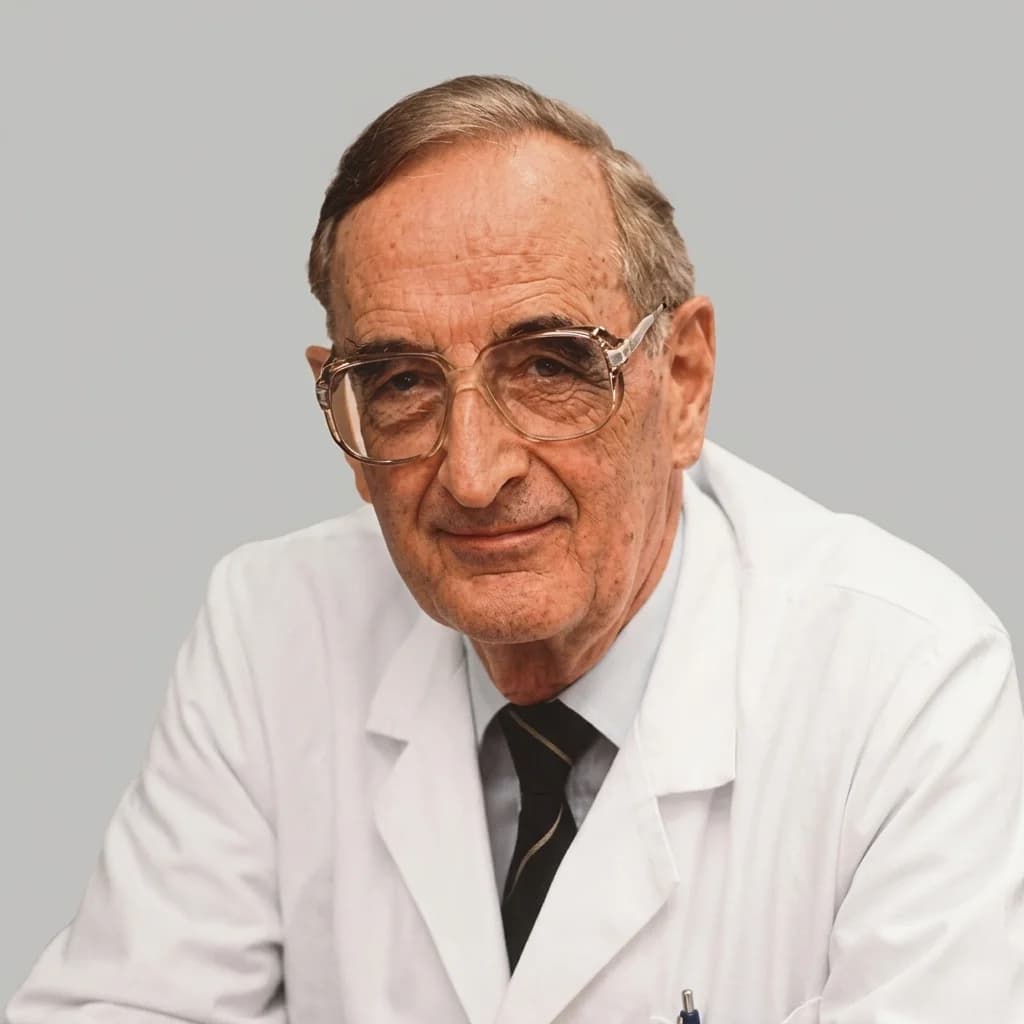
Prof. Walter Siegenthaler
Medical Pioneer & Author of the "Siegenthaler Differential Diagnosis"M.D.
Pioneer of internal medicine. His standard work on differential diagnostics has shaped doctors worldwide for decades in systemic, complex diseases.
Areas of Expertise
Innere MedizinKlinische DiagnostikKlinische PathophysiologieMedizinische LehreDifferentialdiagnose
Research Focus
"A strong doctor diagnoses with ears and eyes at the physical patient bed. Anyone who relies only on a printed A4 lab sheet to heal multisystemic diseases will never heal patients."
Biography & Career
Prof. Dr. Walter Siegenthaler (1923–2010) was one of the most influential German-speaking internists of the 20th century. As Professor of Internal Medicine and Director of the Medical Polyclinic at the University Hospital Zurich, he created an almost monumental life's work that revolutionized medical training for generations. His legendary main work, the "Siegenthaler Differential Diagnosis," remains absolutely indispensable required reading and the undisputed standard reference work at all medical faculties worldwide. Siegenthaler vehemently refused to submit to the increasingly fragmented and mechanical specializations of modern clinical practice. He taught doctors not just to study isolated laboratory values, but to listen to the patient precisely, systematically, and holistically (anamnesis) - an art whose dramatic loss today is largely to blame for the endless misdiagnoses of chronic multisystem diseases like Lyme disease and Post-COVID syndromes.
Technical Deep-Dive
The "Siegenthaler Method" is the intellectual antidote to modern medicine, which often blindly trusts apparatus. In clinical pathophysiology, he postulated the concept that symptoms in isolated organ systems (such as cardiac arrhythmias, cognitive fog, or migrating muscle pain) in chronic infections are almost never locally causal. Rather, they are the fractal echoes of an underlying, masked systemic destruction. In the case of pathogens like Borrelia burgdorferi, which massively invade neurologically or cardiologically (neuroborreliosis, Lyme carditis), specialized medical detail focusing - like the isolated view of a pure cardiologist or pure neurologist - inevitably and fatally leads to a "false track." Siegenthaler warned that the body must be read as a networked bio-reactor.
Myth-Busting
Myth
Symptoms must be treated within a single medical specialty, i.e., neuroborreliosis only by a neurologist.
Fact
Life-threatening fragmentation. A pathogen knows no academic faculty boundaries. Neurotoxic exhaustion from Lyme arises multisystemically through inflammation, vascular occlusions, and biofilms, not through a "local" isolation problem in the brain.
Myth
A negative lab test (ELISA or PCR) always has the final medical say, even if the patient shows obvious symptoms.
Fact
Grossly negligent. Lab tests have limitations, time windows, and sensitivity boundaries (antibody loss). The correct diagnosis of a systemic disease is always - as Siegenthaler demanded all his life - the synthesis of clinical anamnesis, progression, and differential diagnosis, never just a mechanical paper printout.
Expert Quotes
"We have created a medical system in which the doctor has forgotten how to systematically view his patient. He delegates his brain to the laboratory. But the laboratory heals no one; it only provides scraps of data - often even the wrong ones."
Role in VBCI e.V.
Honorary Member (Posthumous). His "Siegenthaler Medical Society" inspires the VBCI through its uncompromising demand for fundamental medical diagnostics over mechanical lab reliance.
Important Medical & Legal Notice
This scientific information is provided for educational and patient guidance purposes only. It does not constitute medical advice, individualized diagnosis, or a promise of cure, and cannot replace a personal consultation with a qualified physician.
Association for the Treatment of Chronic Infections (VBCI e.V.) – Non-Profit Patient Organization.